
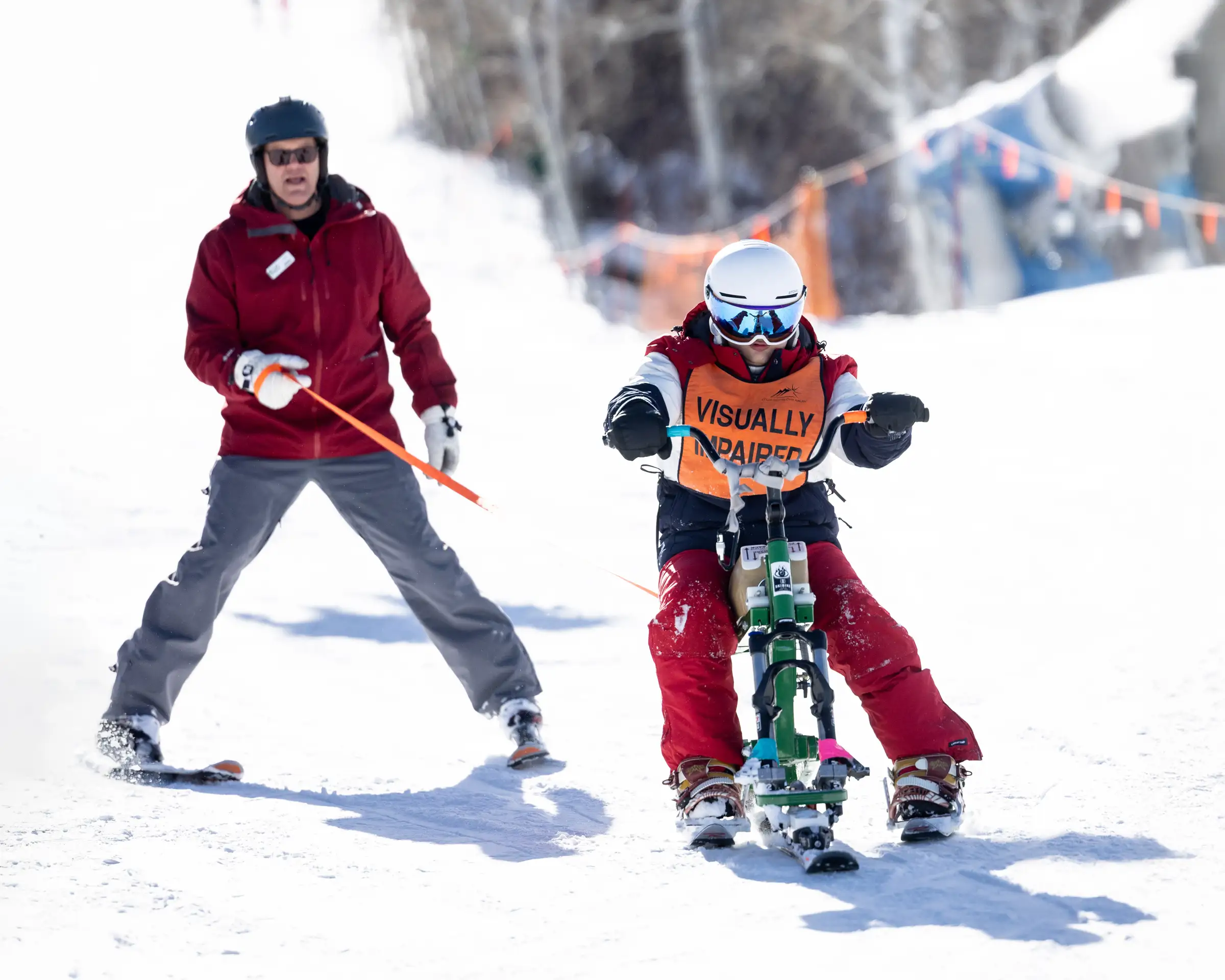
Colorado Discover Ability (CDA) is a local nonprofit that creates inclusive outdoor recreation opportunities for people with disabilities, including adaptive skiing and snowboarding, cycling, sled hockey, and rafting. Their programs make it possible for people of all abilities to participate in activities that are central to life in Western Colorado.
When I first reached out to CDA, it was because I wanted to get to know the community I was spending so much time designing websites for. And, quite honestly, I was also drawn in by the outdoor recreation aspect. I had recently moved to Grand Junction and wanted to meet people. Volunteering with CDA felt like a natural way to do all of that at once.
Spending time with the organization added practical context to the work. Much of what I observed felt familiar, but seeing it play out in real settings added weight.
I saw how outdoor activities that feel straightforward to me, like hiking, cycling, and skiing, often require additional planning, coordination, and adaptation for others. I was introduced to adaptive ski and cycling equipment, and to the reality that those adaptations are highly individualized. What works well for one person may not work at all for another, and flexibility is often more useful than a fixed solution.
At one adaptive ski clinic, I worked alongside an individual with a vision impairment who was there to help guide us during a vision-impaired ski clinic. He wasn’t a participant. He was an experienced instructor, showing us different approaches for supporting skiers safely and consistently.
Throughout the day, accessibility showed up differently depending on the environment. Outdoors, there were the expected physical considerations: icy parking lots, snowy walkways, and navigating from the car to the rental area. Indoors, the barriers were quieter but more limiting. The ski rental software relied entirely on mouse interaction, with no screen reader support and no way to navigate fields using a keyboard. What should have been a routine step became unnecessarily difficult.
The ski lesson itself went smoothly. We skied behind participants, calling out turns using a clear and consistent method. But even that approach was presented as one option among many. Different skiers prefer different techniques, and what works best depends on the individual.
Later, I met that same instructor for coffee to talk about digital accessibility. He works as a vision and support specialist at the Center for Independence, an organization that promotes independent living for people with disabilities across Western Colorado. Our conversation wasn’t about instruction so much as comparison. We talked through different contexts, overlapping challenges, and shared observations. I was excited to meet someone so deeply engaged in improving digital accessibility, including working directly with local city and state officials to help make their websites more usable.
After volunteering with CDA, it also became clear how central CDA’s own website is as a point of access for participants, families, and volunteers, and how many barriers it currently contains. I’ll be rebuilding their website soon and am looking forward to making sure all participants can navigate the site more easily.
Being closer to the community has made the work feel more situated. It’s connected to real places, real systems, and real people.


